U.S. / Cost Guides / Multi-Court Padel Facility Cost

Cost planning guide

Multi-Court Padel Facility Cost

Multi-court facilities need a court budget, a site budget, and an operating model that covers utilization, staffing, parking, and amenities.

Illustration of court supply, groundworks and budget components: Multi-Court Padel Facility Cost

Start with the range

Use a range, not one number.

For a facility, the question is not only cost per court. The better question is whether the court count supports the business model.

Why this matters

What changes the answer for your project

Shared infrastructure may help per-court economics, but amenities, parking, software, staffing, and working capital can add major scope.

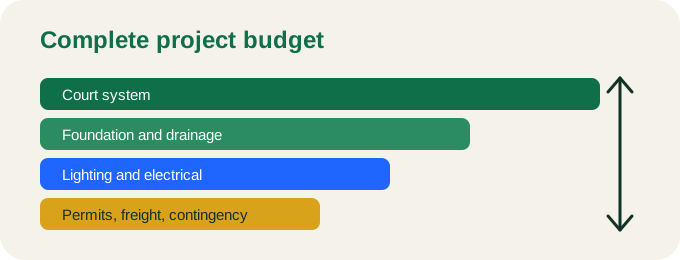
Budget layers for court system, foundations, lighting, permits and contingency

Reviewed 2026-10-08. Confirm the final details for your site and local requirements.

Practical filter

Price the finished project.

Ask every builder to list the court, foundation, lighting, permits, freight, and exclusions separately before you compare totals.

Budget details that move the total

What moves the budget

Cost driver Why it matters Next action
Separate fixed, per-court and capacity-dependent costs Model total investment as fixed setup F + court count n × incremental court cost C + capacity upgrades U(n). Fixed setup may include survey and mobilization; per-court work includes the enclosure, surface and designed base. Capacity upgrades can include drainage, electrical supply, parking, toilets and staff areas. Shared setup does not mean every project cost falls proportionally. Ask the designer and authorities which requirements change at two or four courts, and request a separate price for each layout. Include circulation, maintenance access and the selected courts’ foundations in each site plan.
Compare one, two and four courts using explicit assumptions Hypothetical example only: with F = $20,000, C = $40,000 and no assumed capacity upgrades, one court totals $60,000, two total $100,000 ($50,000 per court) and four total $180,000 ($45,000 per court). This shows fixed-cost sharing; it is not evidence of supplier discounts or actual installation prices. If the four-court layout also needs an assumed $30,000 capacity upgrade, its total becomes $210,000, or $52,500 per court. Replace every assumed input with a scoped proposal. Keep opening cash, lease or land costs, financing and taxes visible outside this simplified construction example.

Include the work around the court

  • Phase construction only after checking that future utility routes, drainage, foundations and access remain feasible. An apparent first-phase saving can become a second mobilization or rework cost. Test the booking model against local demand for all planned courts before committing.

Keep these out of the court-only number

  • The illustrative inputs are not current supplier prices. Obtain scoped local proposals; technical quantities require the designer’s approval.

Questions that deserve a clear answer

  • Check the site, installed-system specification and supplier responsibilities before accepting the budget.

Before you decide

Compare the same project, not just the final number.

Two prices are only comparable when they cover the same work. Check the site condition, court count, indoor or outdoor setting, lighting, cover, permits, access, responsibilities, and project type before choosing an option.

  1. Write down what is included, excluded, provisional, and handled by you.
  2. Ask for written answers to anything that could change the cost or timeline.
  3. Use those answers in the calculator or project brief before comparing builders.

How we checked this page

Sources, dates, and limitations

Editorial responsibility: Padel Calculator. Content revised on . Sources were checked on 2026-06-04, 2026-07-19. Found an error? Please use the contact page.

  • US Padel Court Builders 2026 cost guide Checked 2026-06-04. U.S. complete-project cost components including court system, foundation/site prep, lighting, permitting, and engineering. Limit: Vendor-published cost guidance; use directionally and verify against written local quotes.
  • LTA Padel Court Construction Guidance Note 2025 Checked 2026-06-04. Construction specification considerations for foundation, drainage, lighting, access, and design review. Limit: UK guidance, useful for construction risk framing but not direct U.S. pricing.
  • Padel Calculator modeled assumptions Checked 2026-06-04. Modeled scenarios for comparing scope, contingency, indoor/outdoor setting, covers, and project-readiness decisions. Limit: Planning model only. Replace with written vendor quotes, engineering review, and local permit requirements before committing budget.
  • FIP World Padel Report 2025 release Checked 2026-07-19. Global market-growth context only; it does not validate a specific city, project, price, or vendor. Limit: Market report source, not a construction quote or local permit source.
  • Playtomic and PwC Global Padel Report 2026 Checked 2026-07-19. Country-level participation and market trends; check demand in your own city before investing. Limit: Use as demand context only; verify local operating assumptions separately.

Continue planning

Choose the most useful next step.

Common questions

Answers to check before you commit.

Is this a quote?

No. This is a planning guide. Use it to prepare better questions, then confirm pricing with qualified local vendors.

What usually changes the final cost most?

Foundation/site prep, drainage, lighting, permitting, freight, local labor, and whether the quote covers the complete build or only the court system.

What should I do before contacting builders?

Define court count, site status, indoor/outdoor setting, lighting needs, timeline, budget range, and whether the project team is private, commercial, hospitality, or public-sector.