U.S. / ROI Guides / Padel Club Investment Cost

Business-case guide

Padel Club Investment Cost

Investment cost includes courts, site or building work, soft costs, opening costs, working capital, reserves, and the owner time needed to launch.

Illustration of bookings, operating costs and investment returns: Padel Club Investment Cost

Start with the model

Make the assumptions visible.

Investors should separate court capex from total project capital. The court package is rarely the full investment.

Why this matters

What changes the answer for your project

Split court cost, facility buildout, soft costs, pre-opening spend, and runway before discussing returns.
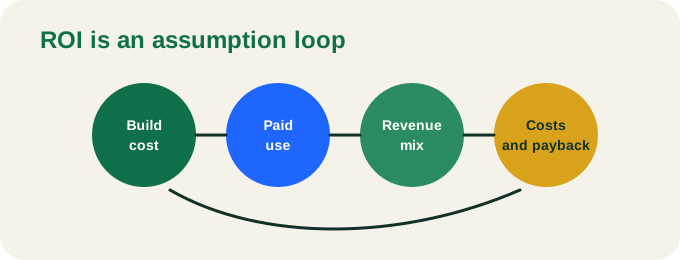
Model connecting investment, paid bookings, operating expenses and payback

Reviewed 2026-10-08. Confirm the final details for your site and local requirements.

Practical filter

Model the operating case before the build.

Use revenue, utilization, operating costs, payback, and working capital together before judging whether a project is investable.

Business-case pressure points

What moves the model

Business driver Why it matters Next action
Court capex Court systems are only one capital bucket. Keep court cost separate from facility cost.
Soft costs Design, permits, legal, insurance, and financing can add up. Add a soft-cost allowance.
Runway Opening does not equal stable utilization. Reserve operating cash.

Model the parts that move payback

  • Build cost, working capital, operating costs, utilization, hourly rate, programming mix, and ramp-up assumptions.
  • Conservative, expected, and optimistic revenue scenarios.
  • Cash reserves for pre-opening marketing, staffing, insurance, maintenance, and slow early months.

Keep these outside the simple case

  • Land value appreciation, tax advice, loan approval, and investor returns unless independently modeled.
  • Revenue from events, food, beverage, pro shop, lessons, or memberships unless the operating plan can support it.

Questions that deserve a clear answer

  • The model uses a strong utilization target before local demand is proven.
  • Build cost is underestimated because site work, leasehold improvements, or working capital are missing.
  • Hourly rate, staffing, programming, and maintenance assumptions are copied from another market without local validation.

Before you decide

Compare the same project, not just the final number.

Two prices are only comparable when they cover the same work. Check the site condition, court count, indoor or outdoor setting, lighting, cover, permits, access, responsibilities, and project type before choosing an option.

  1. Write down what is included, excluded, provisional, and handled by you.
  2. Ask for written answers to anything that could change the cost or timeline.
  3. Use those answers in the calculator or project brief before comparing builders.

How we checked this page

Sources, dates, and limitations

Editorial responsibility: Padel Calculator. Content revised on . Sources were checked on 2026-06-05, 2026-06-03, 2026-07-19. Found an error? Please use the contact page.

  • Padel Calculator modeled ROI assumptions Checked 2026-06-05. Modeled business-case math for utilization, revenue, operating margin, break-even utilization, sensitivity, and payback scenarios. Limit: Planning model only. Not financial advice, valuation advice, lending advice, or a profitability forecast.
  • Padel Calculator cost model Checked 2026-06-05. Build-cost input should be checked against the current cost calculator, written vendor quotes, and local site conditions. Limit: Build cost is only one input in ROI math and must be replaced with project-specific pricing before decisions.
  • FIP U.S. growth article Checked 2026-06-03. Early-2025 U.S. padel court and club coverage signals. Limit: Market snapshot; local supply and demand still require current local validation.
  • FIP World Padel Report 2025 release Checked 2026-07-19. Global market-growth context only; it does not validate a specific city, project, price, or vendor. Limit: Market report source, not a construction quote or local permit source.
  • Playtomic and PwC Global Padel Report 2026 Checked 2026-07-19. Country-level participation and market trends; check demand in your own city before investing. Limit: Use as demand context only; verify local operating assumptions separately.

Continue planning

Choose the most useful next step.

Padel Club Revenue Calculator Guide Use revenue math to test hourly rate, court count, utilization, memberships, lessons, and events before a club plan looks fundable. Padel Court Revenue Projection A useful revenue projection shows how utilization, rate, hours, weather, programming, and seasonality change expected revenue. Padel Facility Feasibility Study A feasibility pass should test site control, court count, capex, demand, pricing, staffing, approvals, and operating runway before vendor quotes drive the Padel Court Demand Validation Guide Demand validation checks whether enough local players, members, guests, tenants, or program users exist before construction cost and ROI assumptions drive Explore roi guides See the related planning decisions. Run the ROI calculator Test the assumptions for your project.

Common questions

Answers to check before you commit.

Is this financial advice?

No. This is planning-first planning guidance. Use it to make assumptions visible, then confirm financing, tax, legal, and investment decisions with qualified professionals.

Which assumption usually matters most?

Utilization is often the fragile input because a small change in paid court hours can change revenue, margin, and payback.

What should I do before asking builders for prices?

Model the business case with realistic build cost, utilization, operating costs, opening costs, and working capital so the quote request matches the investment case.