U.S. / Cost Guides / Padel Court Lighting Cost

Cost planning guide

Padel Court Lighting Cost

Lighting cost can include fixtures, poles, wiring, controls, trenching, glare review, permits, and electrical capacity.

Illustration of court supply, groundworks and budget components: Padel Court Lighting Cost

Start with the range

Use a range, not one number.

Commercial evening play usually makes lighting a revenue input, not an optional accessory. Price it clearly before comparing quotes.

Why this matters

What changes the answer for your project

The calculator separates basic and commercial lighting allowances because club use and night play change requirements.

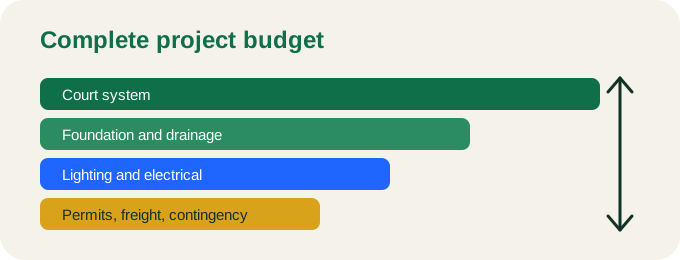
Budget layers for court system, foundations, lighting, permits and contingency

Reviewed 2026-10-08. Confirm the final details for your site and local requirements.

Practical filter

Price the finished project.

Ask every builder to list the court, foundation, lighting, permits, freight, and exclusions separately before you compare totals.

Budget details that move the total

What moves the budget

Cost driver Why it matters Next action
Price the complete lighting and electrical package Request a fixture schedule with quantity, input power and warranty; pole or mounting details; trench and cable lengths; distribution-panel work; controls; installation; and commissioning. Confirm whether the court package includes these items or only the luminaires. A distant power supply or panel upgrade can change the installation budget without changing fixture count. Ask for a photometric plan: a calculation showing illumination, uniformity, glare and light spill for the proposed layout. More fixtures do not by themselves establish acceptable playing conditions. LTA/SAPCA guidance calls for a lighting design and performance documentation; local electrical rules and restrictions on spill or operating hours must be checked for the site.
Calculate running cost from power and use hours Annual lighting energy cost = total fixture input power in kilowatts × annual lighting hours × electricity price per kilowatt-hour. Add control equipment or other loads where relevant. Use lighting hours rather than all opening hours, and use the actual electricity tariff, including demand charges where applicable. Hypothetical example, not a lighting specification or market tariff: eight 200-watt fixtures total 1.6 kW. At 1,000 hours a year and $0.20 per kWh, energy costs $320 per year. At 2,000 hours the same assumptions produce $640. These figures exclude installation, maintenance, taxes and demand charges.

Include the work around the court

  • Request separate replacement prices for drivers and fixtures, access equipment costs and a controls maintenance allowance. Check the lighting design again when changing a fixture model rather than assuming any LED replacement performs the same way.

Keep these out of the court-only number

  • The illustrative inputs are not current supplier prices. Obtain scoped local proposals; technical quantities require the designer’s approval.

Questions that deserve a clear answer

  • Check the site, installed-system specification and supplier responsibilities before accepting the budget.

Before you decide

Compare the same project, not just the final number.

Two prices are only comparable when they cover the same work. Check the site condition, court count, indoor or outdoor setting, lighting, cover, permits, access, responsibilities, and project type before choosing an option.

  1. Write down what is included, excluded, provisional, and handled by you.
  2. Ask for written answers to anything that could change the cost or timeline.
  3. Use those answers in the calculator or project brief before comparing builders.

How we checked this page

Sources, dates, and limitations

Editorial responsibility: Padel Calculator. Content revised on . Sources were checked on 2026-06-04, 2026-07-19. Found an error? Please use the contact page.

  • US Padel Court Builders 2026 cost guide Checked 2026-06-04. U.S. complete-project cost components including court system, foundation/site prep, lighting, permitting, and engineering. Limit: Vendor-published cost guidance; use directionally and verify against written local quotes.
  • LTA Padel Court Construction Guidance Note 2025 Checked 2026-06-04. Construction specification considerations for foundation, drainage, lighting, access, and design review. Limit: UK guidance, useful for construction risk framing but not direct U.S. pricing.
  • Padel Calculator modeled assumptions Checked 2026-06-04. Modeled scenarios for comparing scope, contingency, indoor/outdoor setting, covers, and project-readiness decisions. Limit: Planning model only. Replace with written vendor quotes, engineering review, and local permit requirements before committing budget.
  • FIP World Padel Report 2025 release Checked 2026-07-19. Global market-growth context only; it does not validate a specific city, project, price, or vendor. Limit: Market report source, not a construction quote or local permit source.
  • Playtomic and PwC Global Padel Report 2026 Checked 2026-07-19. Country-level participation and market trends; check demand in your own city before investing. Limit: Use as demand context only; verify local operating assumptions separately.

Continue planning

Choose the most useful next step.

Common questions

Answers to check before you commit.

Is this a quote?

No. This is a planning guide. Use it to prepare better questions, then confirm pricing with qualified local vendors.

What usually changes the final cost most?

Foundation/site prep, drainage, lighting, permitting, freight, local labor, and whether the quote covers the complete build or only the court system.

What should I do before contacting builders?

Define court count, site status, indoor/outdoor setting, lighting needs, timeline, budget range, and whether the project team is private, commercial, hospitality, or public-sector.