U.S. / Planning Guides / Padel Court Glass Thickness

Site planning guide

Padel Court Glass Thickness

Glass selection should be reviewed with court type, structural design, safety, aftercare coverage, wind exposure, installation quality, and replacement support.

Illustration of court layout and surrounding site requirements: Padel Court Glass Thickness

Start at the site

Define the site before the quote.

Glass thickness is one visible spec, but safety and durability depend on the full engineered system and installation quality.

Why this matters

What changes the answer for your project

Compare glass as part of the court system, not as a standalone quality claim.
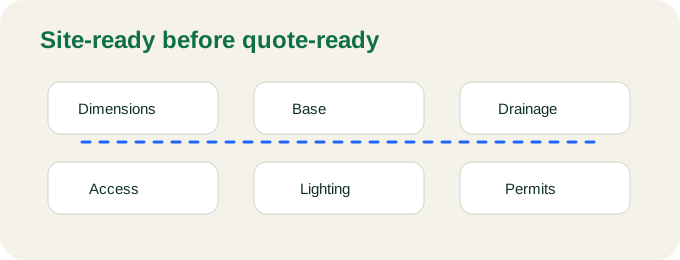
Checklist linking site access, drainage, lighting and approval requirements

Reviewed 2026-10-08. Confirm the final details for your site and local requirements.

Practical filter

Make the site conditions clear.

Share what you know about the site, slab, drainage, lighting, access, permits, and structure before comparing prices.

Site details that change the answer

What changes the project

Planning factor Why it matters Next action
System design Glass works with steel, anchors, and foundation. Ask for full product specs.
Safety and aftercare coverage Replacement and service terms matter. Confirm what is covered and who responds.
Exposure Wind and impact assumptions vary by site. Check structural review for the location.

Confirm before anyone prices the court

  • Site dimensions, access, slab or foundation, drainage, lighting, permitting, wind or structural review, and installation logistics.
  • Who owns engineering, local code review, municipal submissions, inspections, and final handover.
  • Written assumptions for indoor/outdoor setting, cover, amenities, utilities, and future expansion.

Do not assume these are included

  • Any assumption that a generic court-kit quote includes civil work, permits, engineering, electrical work, or site correction.
  • Final engineering, legal, zoning, and permit advice unless provided by qualified local professionals.

Questions that deserve a clear answer

  • A vendor prices the court system before the site is ready to price.
  • Drainage, wind, ceiling height, slab condition, or access issues surface after procurement.
  • The project team compares quotes with different assumptions hidden inside the scope.

Before you decide

Compare the same project, not just the final number.

Two prices are only comparable when they cover the same work. Check the site condition, court count, indoor or outdoor setting, lighting, cover, permits, access, responsibilities, and project type before choosing an option.

  1. Write down what is included, excluded, provisional, and handled by you.
  2. Ask for written answers to anything that could change the cost or timeline.
  3. Use those answers in the calculator or project brief before comparing builders.

How we checked this page

Sources, dates, and limitations

Editorial responsibility: Padel Calculator. Content revised on . Sources were checked on 2026-06-06, 2026-06-04, 2026-07-19. Found an error? Please use the contact page.

  • ASBA and USPA padel court installation manual announcement Checked 2026-06-06. U.S. association announcement says the manual covers dimensions, planning and design, base construction, maintenance, court kits, indoor and outdoor facilities, amenities, lighting, contractor selection, court placement, wind, and soil considerations. Limit: Announcement and manual scope summary, not a substitute for buying the manual, engineering review, permits, or local professional advice.
  • LTA Padel Court Construction Guidance Note 2025 Checked 2026-06-04. Construction specification considerations for foundation, drainage, lighting, access, and design review. Limit: UK guidance, useful for construction risk framing but not direct U.S. pricing.
  • Padel Calculator modeled assumptions Checked 2026-06-04. Modeled scenarios for comparing scope, contingency, indoor/outdoor setting, covers, and project-readiness decisions. Limit: Planning model only. Replace with written vendor quotes, engineering review, and local permit requirements before committing budget.
  • FIP World Padel Report 2025 release Checked 2026-07-19. Global market-growth context only; it does not validate a specific city, project, price, or vendor. Limit: Market report source, not a construction quote or local permit source.
  • Playtomic and PwC Global Padel Report 2026 Checked 2026-07-19. Country-level participation and market trends; check demand in your own city before investing. Limit: Use as demand context only; verify local operating assumptions separately.

Continue planning

Choose the most useful next step.

Padel Court Dimensions for Construction Construction planning should start with court dimensions, clearance, access, slab, drainage, lighting, enclosure, and surrounding circulation. Padel Court Site Requirements Site requirements include space, access, slab or foundation, drainage, utilities, lighting, permits, soil, wind, and installation logistics. Padel Court Project Brief Template A project brief helps vendors understand the project team, site, court count, setting, scope, timing, budget band, and open questions before they quote. Padel Court Site Photo Checklist Site photos help builders see access, surface condition, drainage, utilities, obstructions, surrounding uses, and installation constraints before they quot Explore planning guides See the related planning decisions. Run the cost calculator Test the assumptions for your project.

Common questions

Answers to check before you commit.

Can this replace engineering or permits?

No. Use this as a planning checklist before speaking with qualified local engineers, contractors, permitting authorities, and vendors.

Why do site details matter before quotes?

The same court system can price differently when slab condition, drainage, access, lighting, wind, permits, or indoor building constraints change.

What should I send to a vendor?

Send city and state, site photos, dimensions, indoor/outdoor setting, slab or soil status, lighting needs, access constraints, timeline, and budget band.